I am so giving up on any hope of continuity in this blog. I was looking back through 2009-2010 posts to see what else I've forgotten, and I can't believe I didn't write about my November 2009 trip with Laura (Smith College Chapin house 'little sib'). It was fabulous, so that's what I'm back-blogging about next: our extended-weekend trip to the Nagasaki Penguin Aquarium, Mt. Aso, Kurokawa onsen, and Takachiho.
I met Laura in Fukuoka, and we took the train south to Nagasaki. Our first goal: to pet a penguin! Laura said it had been one of her dreams for awhile, and our trip coincided with the first weekend that the Nagasaki penguin aquarium opened for penguin-pettings (offered outside at a special penguin-petting area during the winter months). We arrived a bit early, though, so first we did some penguin-watching.
 I think this guy posed for us.
 I spent quite a while watching this penguin. He was poised on the top of a cliff-like drop-off with a pool of water at the bottom. I kept thinking he was going to jump: readying his little feet, shifting weight from one to the other like Saki does right before she pounces on something. But nope, this was the Penguin That Did Not Jump.
 Meet the Penguin That Can't Remember if She Left the Gas On...
 ...the Penguin That Just Can't Reach That Itch...
 ...and the "What-are-YOU-Looking-At?" Penguin.
While I was freaking out the penguins (and mentally daring the non-jumper to jump), Laura was having deeper penguin interactions. Possibly even bordering on Penguin Meditation.
Their eyes connected...

...exchanged greetings...

...and enjoyed a quiet moment together.

While seeing penguins on land was pretty cool, watching them swim from below was way cooler.

Who said penguins can't fly?
While still waiting for penguin-petting time, we wandered outside to the beach area and met this fellow. We were going to say hello, but then it was time...

...for penguin-petting!!!
 The penguin didn't feel at all like what I expected. Its feathers were very fune, more like fur, and almost a bit rubbery.

Afterwards, we wandered back down to the fenced-in beach where the penguins had returned to the water. Apparently these were rather warmish-water penguins; Nagasaki isn't all that cold in November.


 I'm squinting against the sun, which was very bright!


For the future reference of my outdoorsy friends and relatives, here are what penguin tracks look like:

We settled into the very friendly hostel (cheap, too; it was the first weekend of off-season prices :) and met Dan (I think his name was..? It is now, anyway), another person planning to climb Mt. Aso the next day. To be technical, we were in the area of the Aso caldera (the largest active volcano in Japan), which has many peaks. Our hostel was near the start of the road up to Mt. Naka, one of the volcanically-active peaks (it's always emitting smoke). It's a long way up by car or bus, though, and since Dan wanted to get an early start and the first bus was later than he was hoping for, we offered him a ride up in exchange for climbing together. The trail maps for the area weren't very good, and he was an experienced climber. (Yes, Uncle Ben, I took a cell phone). You can drive almost all the way up to the volcanically-active area, but we also wanted to climb to a higher peak to look down on Mt. Naka in its steaming glory.


 Here's Dan from behind. We made him leader because, as you can see, there aren't really any trail markers.
 A view of mountains, mist, and more mountains in the distance.
 More Star Trek:TOS set-scenery.
 Dan and Laura were fast.
They also provide good perspective.

 Did I mention it was COLD? ..a climbing-Mt.-Aso-haiku for you:


 ..relative quiet, aside from the crowds near the traditional Japanese craft-y shops, and the guests staying at high-class ryokan clopping about in geta (traditional wooden shoes) from one onsen to the next.
 Laura's also very into photography, so we chatted for a bit about picture-taking. This guy was headed around Kyushu the next day to take pictures of the Aso area before heading back to his home near Fukuoka. He offered to take us part of the way to Takachiho, our next stop, and show us scenic spots along the way. How could we resist?


 I think our guide said that this is the longest covered wooden bridge in Japan. Maybe.
 It was certainly very scenic!

The Aso Caldera peaks from afar:
 Eventually, our guide left us to our GPS, and we made our way to Takachiho in Miyazaki prefecture. We went there to see a few things: the Ama-no-Iwato shrine, the Amano Yasugawara Cave, and Takachiho gorge, a scenically-famous gorge with a waterfall.
Ama-no-Iwato Shrine is dedicated to the cave that Amaterasu hid in. I didn't know it until we got there, but you can't actually go inside the cave. You can't, actually, really even see the cave from Ama-no-Iwato Shrine. The shrine complex is sprawling, and from the back of one of the buildings, you can see across an undeveloped chasm. Amaterasu's "cave" is on the other side... blocked off as it has been since she came out of it so long ago. Because the "cave" is so sacred, you aren't allowed to take pictures, either. So I do apologize; I am unable to share with you a picture of the closed-cave which used to house Amaterasu.
Somewhat let-down by the thrawted excitement of seeing Amaterasu's "cave" (which is no longer a cave), we went down a path to the Yasugawara Cave, the spot where the other gods met and discussed how they could make Amaterasu come out of her cave. On the way, there were a bunch of small stalls selling snacks and other foodstuffs, including ginko nuts.

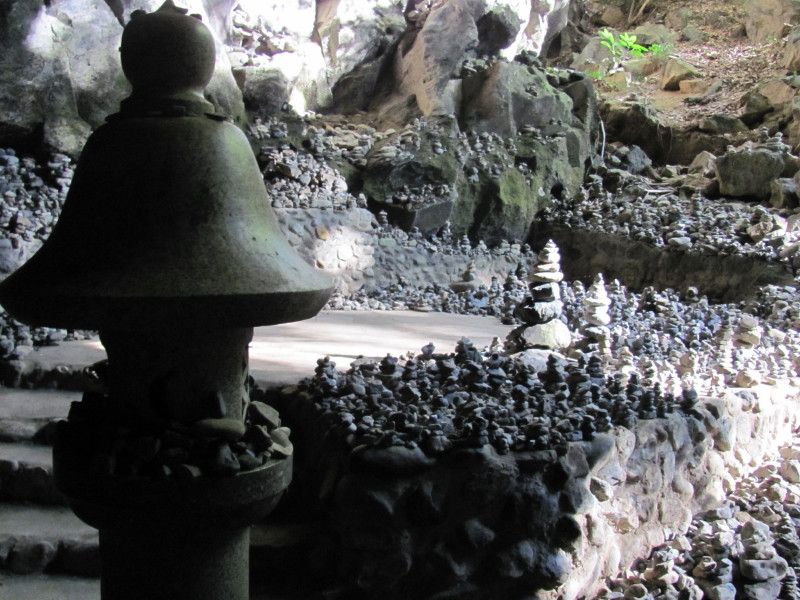
After a delightful walk beside a stream in the forest, we got to Yasugawara Cave, and oh, how it made up for the earlier disappointment! For starters, it was much more cave-like.
 AND many pilgrims over the years have made little rock piles, which were just gorgeous in the cave and forest's dappled light. Seriously, there were thousands of them. Tens of thousands, even.

 Highly satisfied, we continued onto our next stop: Takachiho Gorge!
 I was very happy at the first gorge-like signs.

With slightly different coloration, could almost be mistaken for a loon, huh?

And then, lo and behold, the penguins decided they'd had enough swim-time; out of the water they came, waddling over the sand to greet us!


 I'm squinting against the sun, which was very bright!

The penguins coming out of the water was quite funny, for some reason it made me think of a jail break. We weren't allowed contact with these penguins, however. Because we were allowed inside their fence onto the beach, their handlers were waiting to hold them back, keeping them just inches out of our reach. The waddle of penguins spread out and tried multi-pronged charges through the line, but alas, the handlers were too good at their jobs.


For the future reference of my outdoorsy friends and relatives, here are what penguin tracks look like:

From Nagasaki, Laura and I took an interesting route-- a train to Shimabara (the rural southern tip of Nagasaki prefecture), then a ferry to Kumamoto, a bus into the middle of the city, and a rental car from Kumamoto city to a hostel at the foot of Mt. Aso. It was a rather long time traveling but put us right where we wanted to be: the middle of Kyushu and set up to climb Mt. Aso and drive to Kurokawa onsen the next day. (I really wanted to go to the Kurokawa onsen area, since it's rumored to be the basis for the bathhouse in "Spirited Away," but it's very difficult to reach without a car). The rental car also gave me the opportunity to drive in mainland Kyushu with my well-earned Nagasaki prefecture driving license. I'm very glad we got a GPS too; it was extremely helpful!
We settled into the very friendly hostel (cheap, too; it was the first weekend of off-season prices :) and met Dan (I think his name was..? It is now, anyway), another person planning to climb Mt. Aso the next day. To be technical, we were in the area of the Aso caldera (the largest active volcano in Japan), which has many peaks. Our hostel was near the start of the road up to Mt. Naka, one of the volcanically-active peaks (it's always emitting smoke). It's a long way up by car or bus, though, and since Dan wanted to get an early start and the first bus was later than he was hoping for, we offered him a ride up in exchange for climbing together. The trail maps for the area weren't very good, and he was an experienced climber. (Yes, Uncle Ben, I took a cell phone). You can drive almost all the way up to the volcanically-active area, but we also wanted to climb to a higher peak to look down on Mt. Naka in its steaming glory.
The day of our hike was a bit overcast and chilly but otherwise looked good. These are some pictures I took on the way up the road (no climbing yet).
The steaming Mt. Naka--

A smaller caldera in the opposite direction

..and then we were there! It was quite windy out in the open.

...and just in case the volcano decided to erupt, there were shelters off to the side designed to protect people from falling rocks, etc. I know sometimes things happen unexpectedly, but the volcano is actively monitored, and there are daily forecasts of amounts of ash released (on expecially bad days, people with asthma are advised to wear masks, and sometimes the area closes to tourists).

There was a little jizo-statue near the summit, also protecting us from harm.
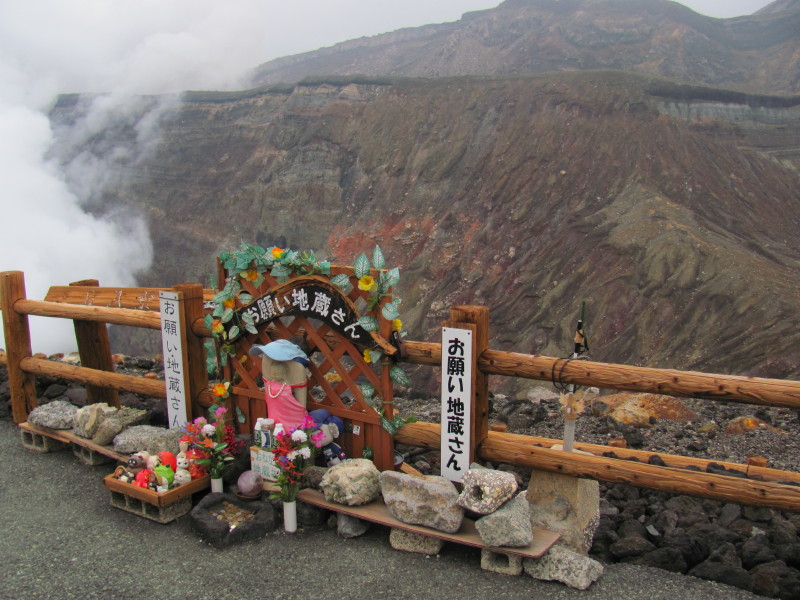
It was really hard to take a picture of the inside of the crater, but I hope you can see the greenish water. It was murky and way cool.

The landscape was insane, too. Walking around the crater and especially later, when we began the climb up, the scenery was so different from anything else I've ever experienced. It reminded me of the set of an old Star Trek episode (like that one where the goo comes to life and replicates the crew).

 Here's Dan from behind. We made him leader because, as you can see, there aren't really any trail markers.
 A view of mountains, mist, and more mountains in the distance.
 More Star Trek:TOS set-scenery.
I was really wondering if a monster was going to jump out from behind those rocks.
 Dan and Laura were fast.
They also provide good perspective.

Not quite there yet. The place we were trying to climb to is actually engulfed in the steam/ash-cloud, to the right. When we got there, we couldn't see much. So this will have to do.
 Did I mention it was COLD? ..a climbing-Mt.-Aso-haiku for you:
That's an icicle.
Right next to the volcano.
Why no monsters yet?

Another peak facing away from Mt. Naka.
So very surreal for this native low-lander!

Doesn't this look photo-shopped? (it's not, really!)

We finally got to where we were going and couldn't see anything. Well, except for this old Japanese man coming along the knife's-edge path that we just came across.

After descending, we were thoroughly frozen Laura and Kim-cycles. It was high time to soak in some onsen! We took the rental car, punched in Kurokawa onsen, and were on our way. For obvious reasons I couldn't take any pictures inside the onsen (I think all the naked Japanese ladies on our side would've protested, with just cause), but here is the onsen town:
 ..relative quiet, aside from the crowds near the traditional Japanese craft-y shops, and the guests staying at high-class ryokan clopping about in geta (traditional wooden shoes) from one onsen to the next.
After a great soak in beautiful rotenburo (outdoor baths), we headed to our hostel. Might I put in another plug for hostels? I don't know why I'd stay anywhere else in Japan; they're much cheaper than other accomodations, by at least half usually, and in more rural areas you can usually get a home-cooked breakfast too. (Ours included a specialty of the area, raw horse... which the hostel-owner refused to identify until we'd tried it, but I had my suspicions).
At the hostel, we also met this man, a camera afficionado.
 Laura's also very into photography, so we chatted for a bit about picture-taking. This guy was headed around Kyushu the next day to take pictures of the Aso area before heading back to his home near Fukuoka. He offered to take us part of the way to Takachiho, our next stop, and show us scenic spots along the way. How could we resist?
Pictures from our drive:


I won't even try to count how many pictures I took of this, trying to get it just right. What miraculous Japanese plant is this, you might ask? Acutally, it's a weed. I just think it looks gorgeous when struck by sunlight.


 I think our guide said that this is the longest covered wooden bridge in Japan. Maybe.
 It was certainly very scenic!

The Aso Caldera peaks from afar:
 Eventually, our guide left us to our GPS, and we made our way to Takachiho in Miyazaki prefecture. We went there to see a few things: the Ama-no-Iwato shrine, the Amano Yasugawara Cave, and Takachiho gorge, a scenically-famous gorge with a waterfall.
Our first stop was Ama-no-Iwato Shrine, which is very famous in Japanese mythology. As the story goes, Amaterasu (the sun goddess), got mad at the other gods and hid herself away in a cave... of course, blocking out all of her sunlight and plunging the world into darkness at the same time! The gods got together at another cave/rock out-cropping nearby and plotted what they could do to make her come out. Eventually, one god started dancing, and it was so funny that the other gods were all ROFL (they did invent it, you know). Amaterasu heard the laughter and, interested, peeked out. A mirror that had been placed in the cave's direction allowed her to see her own beautiful reflection, drawing her out further. The other gods sealed her cave so she couldn't go back inside, and thus, light was returned to the world.
Ama-no-Iwato Shrine is dedicated to the cave that Amaterasu hid in. I didn't know it until we got there, but you can't actually go inside the cave. You can't, actually, really even see the cave from Ama-no-Iwato Shrine. The shrine complex is sprawling, and from the back of one of the buildings, you can see across an undeveloped chasm. Amaterasu's "cave" is on the other side... blocked off as it has been since she came out of it so long ago. Because the "cave" is so sacred, you aren't allowed to take pictures, either. So I do apologize; I am unable to share with you a picture of the closed-cave which used to house Amaterasu.
Here's some beautifully carved beams of one of the buildings, though (oo, flashback to a particularly painful JYA art course: PURLIN!)

Somewhat let-down by the thrawted excitement of seeing Amaterasu's "cave" (which is no longer a cave), we went down a path to the Yasugawara Cave, the spot where the other gods met and discussed how they could make Amaterasu come out of her cave. On the way, there were a bunch of small stalls selling snacks and other foodstuffs, including ginko nuts.

After a delightful walk beside a stream in the forest, we got to Yasugawara Cave, and oh, how it made up for the earlier disappointment! For starters, it was much more cave-like.
 AND many pilgrims over the years have made little rock piles, which were just gorgeous in the cave and forest's dappled light. Seriously, there were thousands of them. Tens of thousands, even.
 Highly satisfied, we continued onto our next stop: Takachiho Gorge!
 I was very happy at the first gorge-like signs.
And then, the classic image from all the "Takachiho Gorge" posters--
 Absolutely gorgeous!!
 You can rent little rowboats and row out to the main waterfall area (many of the boats got into my pictures), but unfortunately we got there late in the day and all the boats were already reserved until dusk. So we headed back to town to see Takachiho Shrine.
 This is a visual pun. We were heading to Takachiho Shrine (a small, local affair compared with the previous nationally-renouned Ama-no-Iwato Shrine), and this was on the opposite side of the road. The sign says "Takachiho Health Office," and it's pointing to a mini-shrine! ..as if, in this town of historical spiritual connections, if you're sick then it's to the shrine for you!
 Oh, I should note that there was a series of masks (picture of a group of them to come later) that were used in some of the performances. I think that, like noh theater, they represent certain characters/demons/gods or a type of character.
 Two different masks in play
 There was a very long dance involving four men with this instrument studded with bells. It had a bunch of long ribbons attached to it, too.
 I'm not really sure what the dance was about, but there's a video of part of it on YouTube: www.youtube.com/watch?v=z9S47RH8VjA&feature=related I took some videos, too.
 Bell-studded instruments (I really loved them; wikipedia says that they are "Kagura suzu") and bows this time.
 Although the dancers sometimes used the bell-studded instruments, most of the percussion was performed by separate musicians. It was mostly the occasional beat of a drum.
 These are some of the masks used in the dances.
One more mask picture to come later on! A really cool sword-dance. It started off with one dancer performing the movements, and gradually others entered in to involve 4 dancers at the end. The stage is rather small, and it was impressive to see all of them performing the same movements in unison within such a small space.
 He's got my new favorite instrument!
 I don't think all 33 of the dances were performed that night because of the special harvest festival, which was after the dances and not too late-- according to all the tourist info, when all of the dances are performed it goes on until dawn. But maybe they just got an earlier start than usual. In any case, the above picture is of the rotating titles of the dances. As one ended, someone would flip to the next dance's title, and it would begin immediately.

Beginning of crazy sword-dance:
 Note that he's holding a very long sword by its end.
 Now, he is leaning really far back, sword still in hand, and waving it about.
 My camera couldn't really capture anything but the motion; like the other sword-dance, other members joined in as time went on, and they got progressively faster. Even watching from the audience, their arms were blurs.
 Note the cut-paper hung around the stage; discussion to come later.

And the "wife" (remember that all dancers are male, even the female roles):

I got the dancers with the name of this dance, in case anyone is interested.

 The promised second half of the masks.
 Oh, yes, and the cut-paper hanging! I chatted with one of the locals about them (there were cloth prints of the pattern for sale), and if I remember right these are hand-made. They're also a design specific to Takachiho.

There is more info about the Yokagura dances from the local tourist center at: http://www.town-takachiho.jp/culture/tourism/entry100702450.html
 Absolutely gorgeous!!
Walking further up the gorge, nice mini-waterfalls, too.
 You can rent little rowboats and row out to the main waterfall area (many of the boats got into my pictures), but unfortunately we got there late in the day and all the boats were already reserved until dusk. So we headed back to town to see Takachiho Shrine.
 This is a visual pun. We were heading to Takachiho Shrine (a small, local affair compared with the previous nationally-renouned Ama-no-Iwato Shrine), and this was on the opposite side of the road. The sign says "Takachiho Health Office," and it's pointing to a mini-shrine! ..as if, in this town of historical spiritual connections, if you're sick then it's to the shrine for you!
I was very surprised when we got to Takachiho Shrine. I knew that there were nightly Yokagura dances, a kind of Shinto dance to reinact Shinto myths as written in the Kojiki, the oldest chronicle of Japan and dating from the 8th century. (The dances are also sometimes just called "Kagura".) The particular night that Laura and I went, however, was one of their special longer performances! The men of the town (no women are allowed in the dances) performed many of the dances, followed by a special harvest blessing ceremony.
We didn't stay for many performances (it was --very-- cold, and I was catching a cold; we watched a bit, retreated to the local onsen, and came back for the grand harvest blessing finale). It was also difficult to take pictures with the fast movements of the dancers and the low light of the shrine, but here's some of what we saw:
 Oh, I should note that there was a series of masks (picture of a group of them to come later) that were used in some of the performances. I think that, like noh theater, they represent certain characters/demons/gods or a type of character.
 Two different masks in play
 There was a very long dance involving four men with this instrument studded with bells. It had a bunch of long ribbons attached to it, too.
 I'm not really sure what the dance was about, but there's a video of part of it on YouTube: www.youtube.com/watch?v=z9S47RH8VjA&feature=related I took some videos, too.
 Bell-studded instruments (I really loved them; wikipedia says that they are "Kagura suzu") and bows this time.
 Although the dancers sometimes used the bell-studded instruments, most of the percussion was performed by separate musicians. It was mostly the occasional beat of a drum.
 These are some of the masks used in the dances.
One more mask picture to come later on!
 A really cool sword-dance. It started off with one dancer performing the movements, and gradually others entered in to involve 4 dancers at the end. The stage is rather small, and it was impressive to see all of them performing the same movements in unison within such a small space.
 He's got my new favorite instrument!
 I don't think all 33 of the dances were performed that night because of the special harvest festival, which was after the dances and not too late-- according to all the tourist info, when all of the dances are performed it goes on until dawn. But maybe they just got an earlier start than usual. In any case, the above picture is of the rotating titles of the dances. As one ended, someone would flip to the next dance's title, and it would begin immediately.

Beginning of crazy sword-dance:
 Note that he's holding a very long sword by its end.
 Now, he is leaning really far back, sword still in hand, and waving it about.
 My camera couldn't really capture anything but the motion; like the other sword-dance, other members joined in as time went on, and they got progressively faster. Even watching from the audience, their arms were blurs.
 Note the cut-paper hung around the stage; discussion to come later.
The last dance that Laura and I saw before our retreat to the onsen was a funny one, followed by a break for the dancers. Even not knowing what the play was about going in, it was still funny: the story was clearly about a husband and wife's squabbles. Here's the husband:

And the "wife" (remember that all dancers are male, even the female roles):

I got the dancers with the name of this dance, in case anyone is interested.

 The promised second half of the masks.
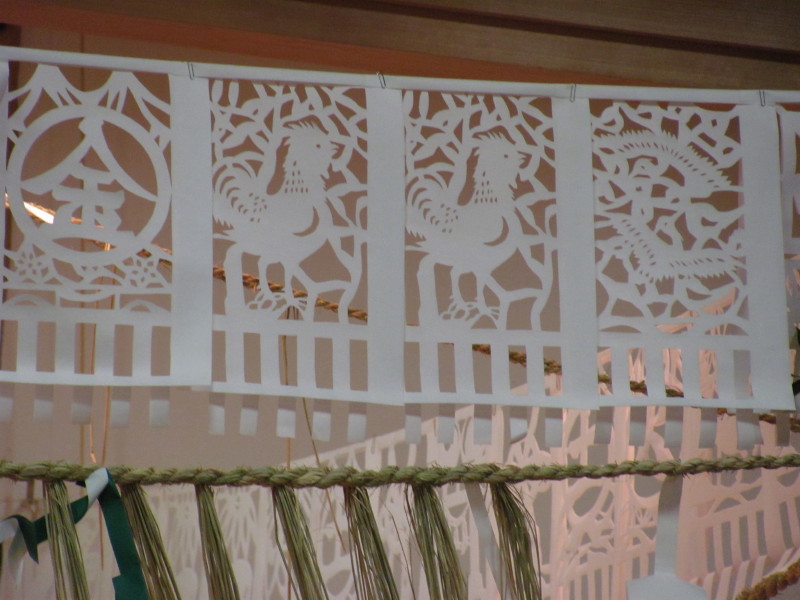 Oh, yes, and the cut-paper hanging! I chatted with one of the locals about them (there were cloth prints of the pattern for sale), and if I remember right these are hand-made. They're also a design specific to Takachiho.

There is more info about the Yokagura dances from the local tourist center at: http://www.town-takachiho.jp/culture/tourism/entry100702450.html
...and the article is very accurate. Laura and I were able to feast on some of the delicious stew the town's group of obaachans kept late into the night : )
We headed off to the onsen, then, warmed up, and went back for the grand harvest festival finale. I don't have any pictures or videos because it was a participatory activity. There were ropes strung from a mikoshi (portable-shrine/temporary abode of a deity), which sat outside, into the deity's normal home inside the shrine. All of the villagers (and temporarily adopted villagers, which included me) stood inside the shrine on the tatami mats where we had just been sitting to watch the dances. There were many ropes leading in from the mikoshi, and people stood in lines in between the ropes. The ceremony, I think, was meant to bring the deity back from the mikoshi into its normal home inside the shrine because that day's special festival was at an end. This involved a bunch of guys chanting while all the people in and around the ropes slowly swayed them back and forth, right and left... increasing speed as the chanters did, until we were bashing into the next line of people over and a few seconds later being bashed right back.
Try to imagine a sacred Shinto mosh pit. It was something like that.
It was also pretty awesome. I can still remember the incredible excitement and energy-- the local deity, after all, had to move along the ropes through the crowd to get from his/her mikoshi to the figurative home base. So everyone in that sacred mosh pit got touched by a god. It was a lot of fun, too, I kept laughing and then trying not to laugh because I had to focus on keeping my footing; I certainly didn't want to get trampled by the gods, much less the spirit-high energetic obaachans around me. And, of course, keep on bashing.
Being part of the harvest ceremony ranks as one of my top 5 special moments in Japan. I'd definetely go back to Takachiho again!